Which TUSD Schools Could Close, and What Happens Next
Tucson Unified's superintendent recommends closing seven schools over the next two school years, three in 2027-28 and four in 2028-29. The Governing Board could vote Dec. 8. Here are the schools, the district's reasons, what families have been promised and how to weigh in.
Nothing has been decided. The five-member board can approve all, some or none of the recommendations. This is what we know as of Nov. 11, the day after the board reviewed the last of the proposals. We'll update this page as the board meets.
The short version:
- Three schools would close starting in the 2027-28 school year: Hudlow, Cragin and Collier elementaries.
- Four more would follow in 2028-29: Magee and Secrist middle schools and Cavett and Steele elementaries. Magee was first proposed for 2027-28.
- Dunham Elementary is off the list. Superintendent Gabriel Trujillo told families Nov. 6 that the district no longer recommends closing it, citing its academic record.
- The next meetings: a public hearing Nov. 17 at Sahuaro High School, a board question-and-answer session on the plan Dec. 1 and a possible vote Dec. 8 at Palo Verde High Magnet School.
- The stated savings: about $4.6 million a year for all seven, by the district's estimates. The superintendent has said up to $7 million.
- The district's reason: enrollment. TUSD has lost more than a quarter of its students since 2010, and it has far more seats than students.
Which schools would close?
These are the seven recommendations on TUSD's Reconfiguration page as of Nov. 11. In each case, the district recommends closing the first school and moving its students to the second.
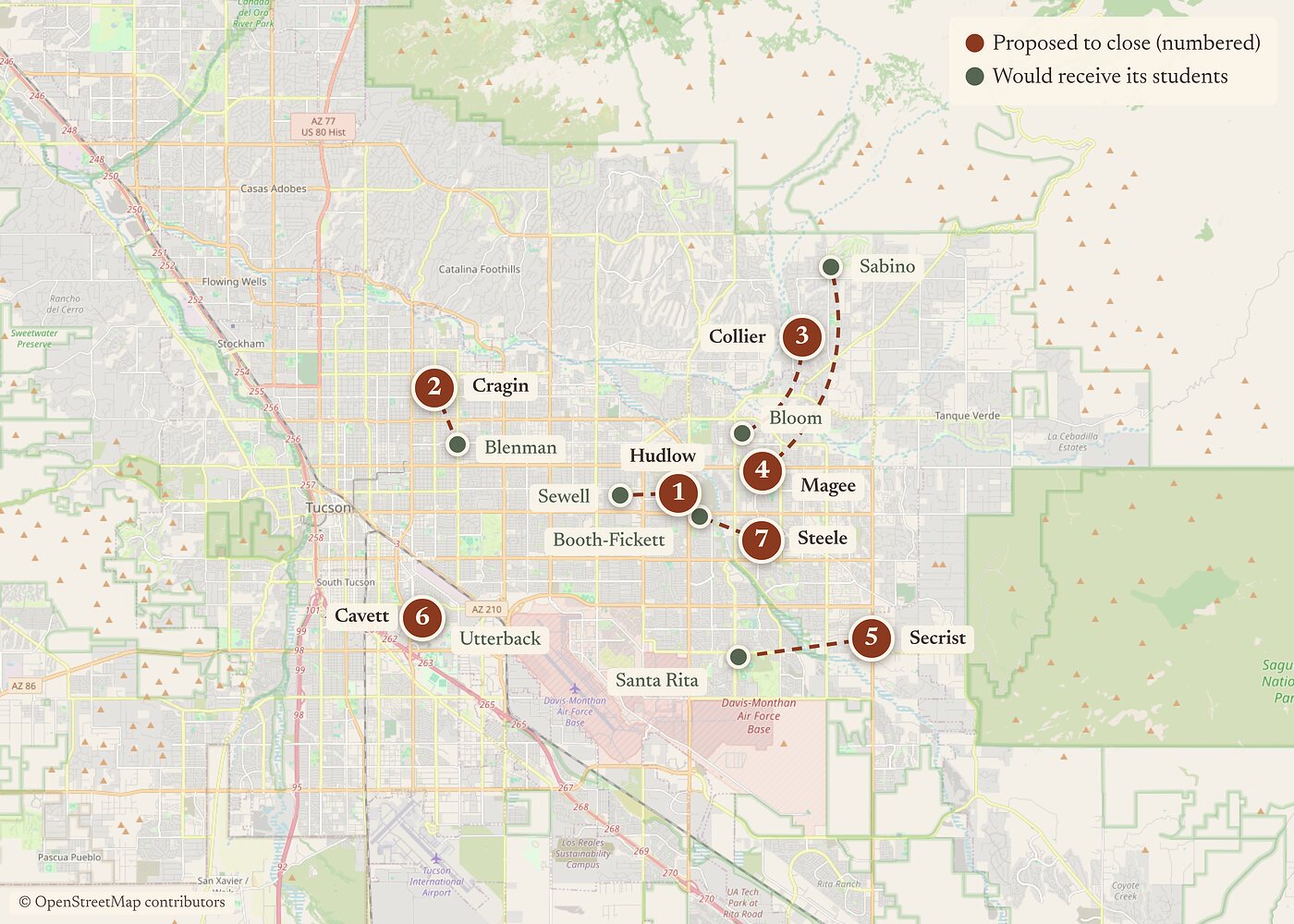
| # | Would close | Students | Would move into | Distance | Estimated savings a year | School year |
|---|---|---|---|---|---|---|
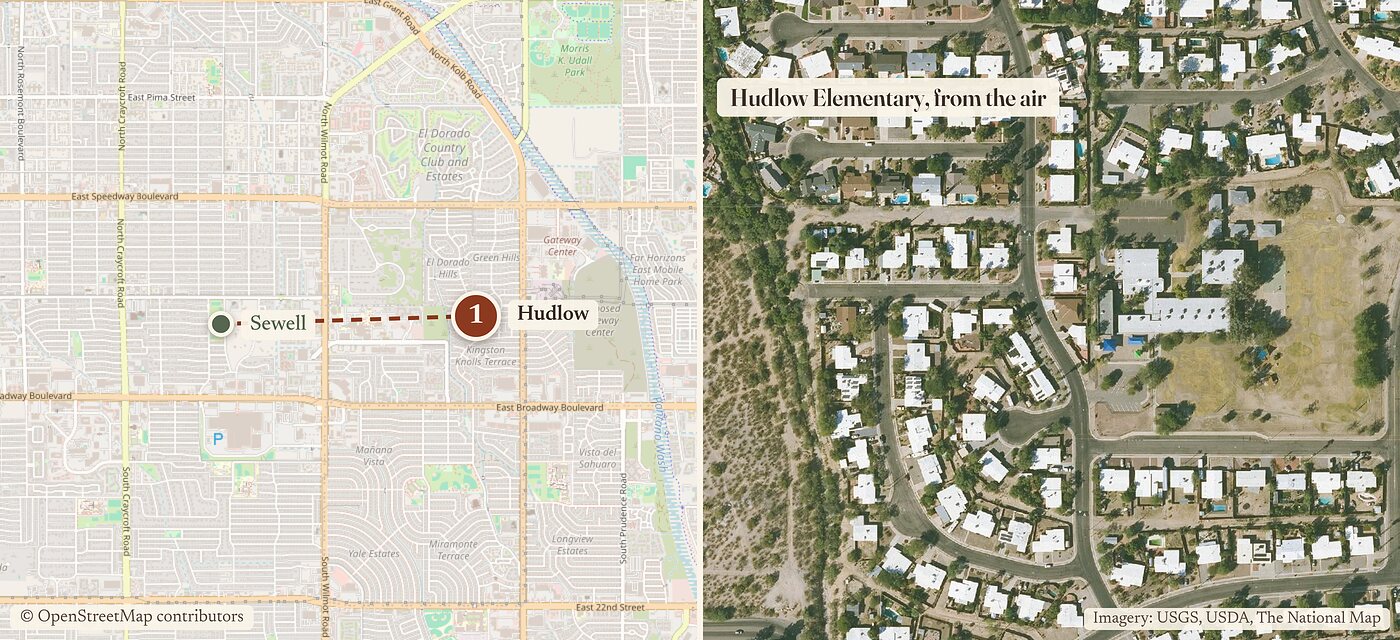
| 1 | Hudlow Elementary | 132 | W. Arthur Sewell Elementary | 2.5 mi | $494,940 | 2027-28 |
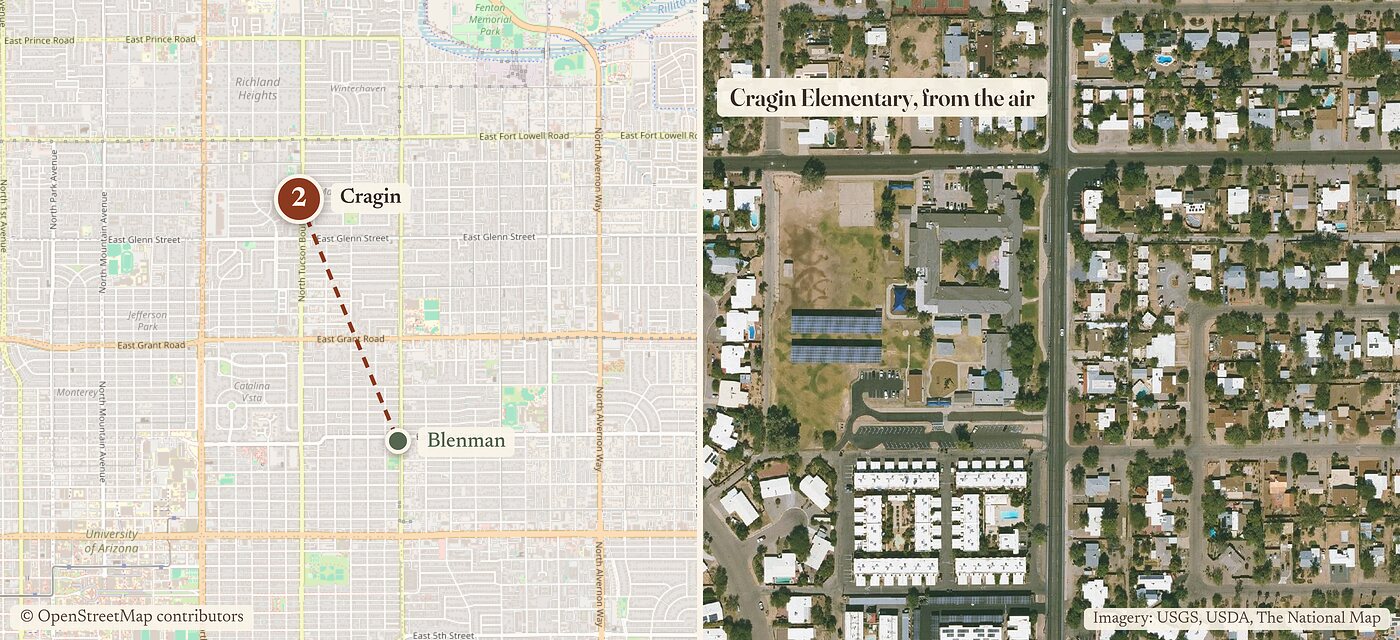
| 2 | Cragin Elementary | 177 | Blenman Elementary | 1.9 mi | $660,556 | 2027-28 |
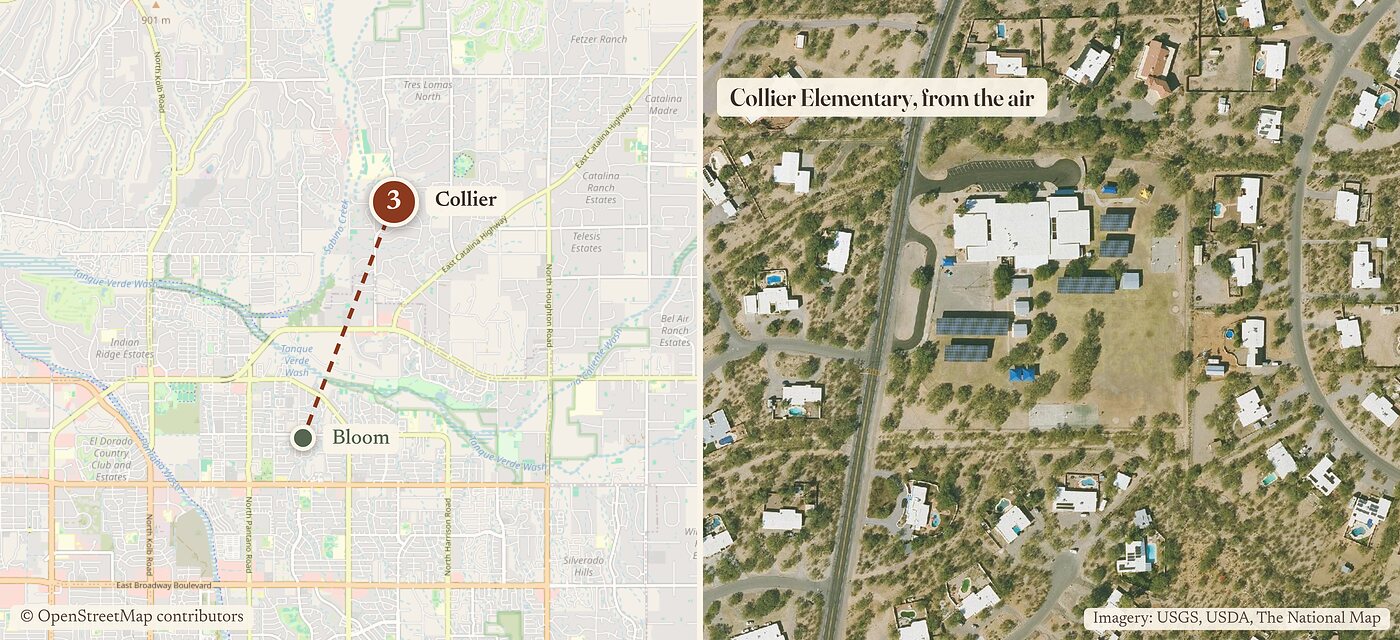
| 3 | Collier Elementary | 93 | Bloom Elementary | 4 mi | $1,030,643 | 2027-28 |
| 4 | Magee Middle School | 266 | Sabino High School | 7 mi | $514,482 | 2028-29 |
| 5 | Secrist Middle School | 199 | Santa Rita High School | about 5 mi | $436,723 | 2028-29 |
| 6 | Cavett Elementary | 203 | Utterback Middle School | about ¼ mi | $928,964 | 2028-29 |
| 7 | Steele Elementary | 194 | Booth-Fickett K-8 | about 2 mi | $518,666 | 2028-29 |
Student counts and savings are TUSD's, from fall 2026. The first four come from the Oct. 27 board packet, and the last three from the district's Nov. 10 financial overview. The miles for the last three are road distances we measured or the Tucson Sentinel reported.
School by school
1. Hudlow to W. Arthur Sewell. The two schools are about the same size, 132 and 125 students. Trujillo said Sewell was chosen because of money already spent or committed there: $1.4 million for air conditioning, $1.8 million for water lines and a state grant for a new roof. "That was the tipping point," he said, "because really both schools are very, very similar." The packet would have sent Hudlow's self-contained special education classes to a third school, Kellond. Trujillo told the board on Oct. 27 that they will go to Sewell instead.
2. Cragin to Blenman. Trujillo said Blenman has the larger campus and has received more bond money, $1.6 million against $485,000 at Cragin. He also said an engineer's report on cracks in Cragin's classrooms points to major foundation work, and that the school may need new water lines. Blenman would go from 288 students to a projected 424. Cragin's families have asked the district to study moving Blenman into Cragin instead.
3. Collier to Bloom. Collier is the smallest regular campus in TUSD and the largest savings on the list. Trujillo said it costs $1.6 million a year to run, close to $1 million more than it brings in. The merger would cut six teaching jobs and about seven others. Bloom has no room for a sixth grade, so Collier's sixth graders would go elsewhere. A petition asking the district to keep Collier open, as a K-8 or a conservation magnet, had more than 900 signatures as of Oct. 31.
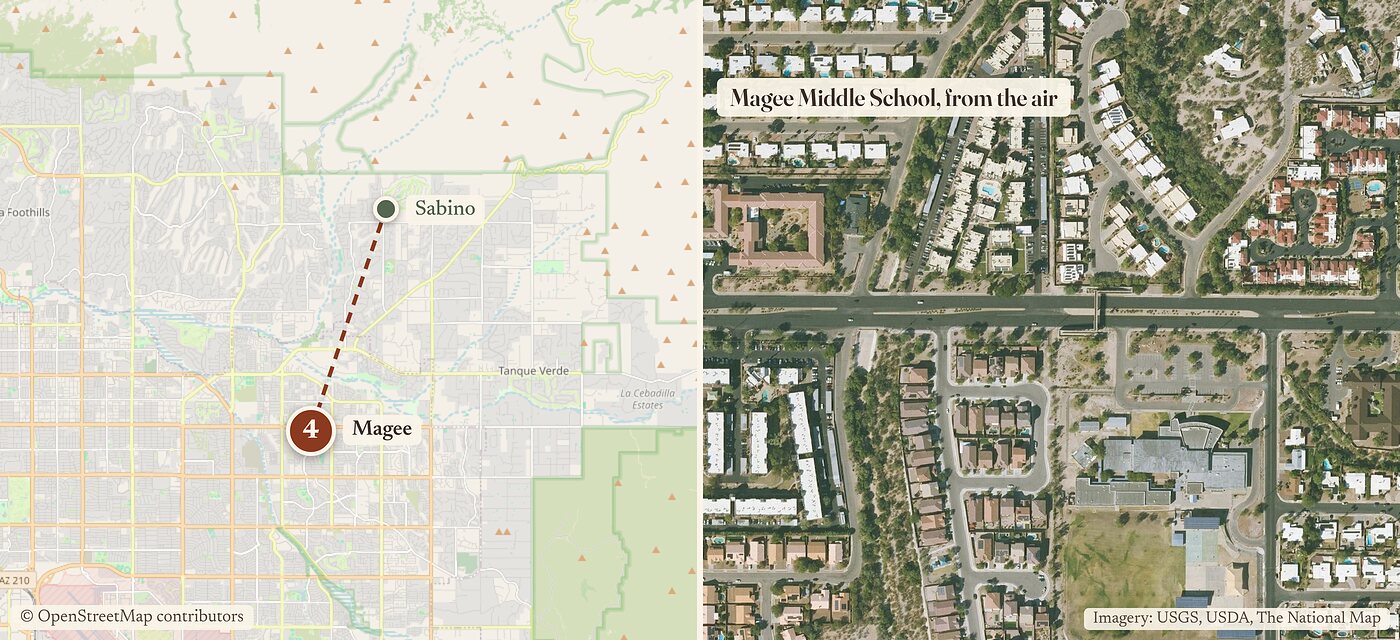
4. Magee to Sabino (2028-29). This would make Sabino a grades 6-12 campus with a middle school "secondary academy." Trujillo described a separate bell schedule, building, teachers, sports and lunch. He said a Sabino classroom wing was renovated for a similar plan around 2013, though art and music rooms would still need bond money. It's the longest move on the list, at 7 miles by the district's count, and the district says it would run nonstop express buses. Shaw suggested keeping Magee and making Sabino grades 7-12, or turning Magee into a K-8. Feedback from Magee staff that TUSD posted on its Reconfiguration page questions the district's figures. One letter notes that the scenario sheet lists $700,000 in savings, while the staffing and cost summary lists $514,482, the figure in our table.
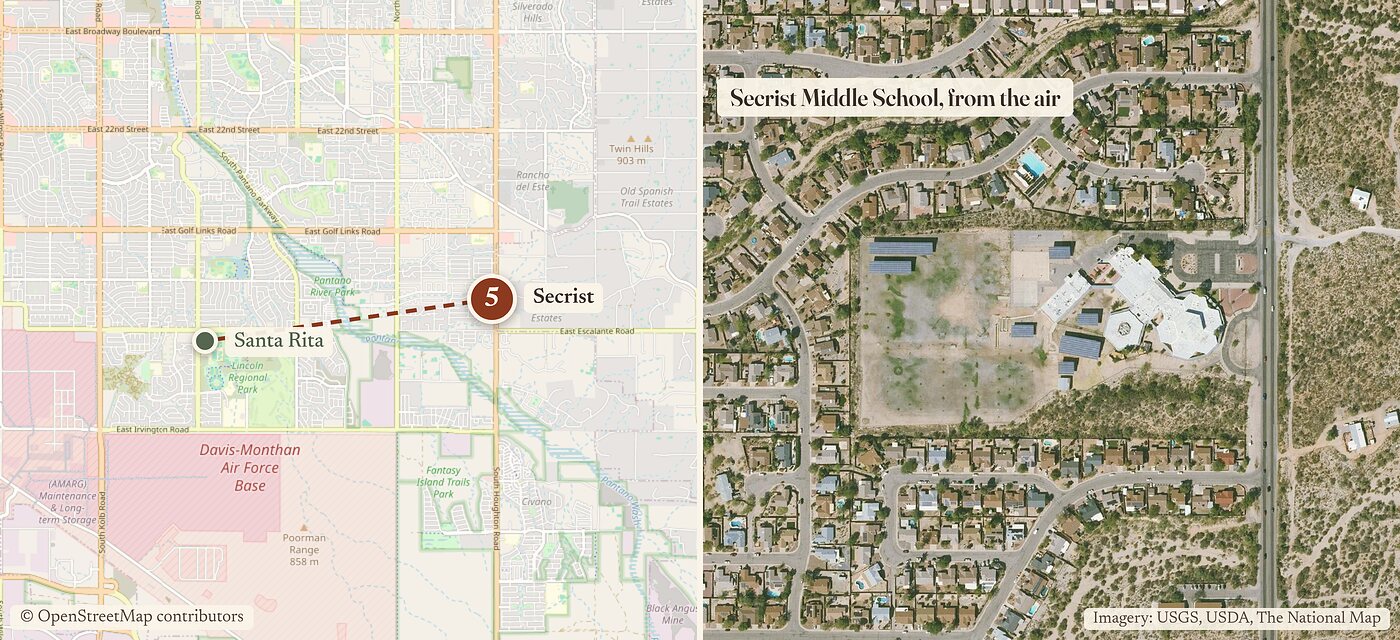
5. Secrist to Santa Rita (2028-29). Secrist's grades 6-8 would move into a "secondary academy" at Santa Rita High, the Tucson Sentinel reported, with a separate building, classes, lunch and bells. Together the schools have 604 students, 199 at Secrist and 405 at Santa Rita. The district's Nov. 10 presentation projects the campus at 26% of capacity even after the move. By the state's count, Santa Rita has fallen from 1,098 students in 2010. The plan would cut two teaching positions, and Secrist's principal would become the middle school principal at Santa Rita. The district describes a career and technical education program for grades 6-8, at $525,000 for roughly 600 students. Trujillo said bond money earmarked for Secrist could go to Santa Rita, the Arizona Daily Star reported. Santa Rita was built for about 2,000 students, Trujillo told the board Nov. 10. "It's not gonna get there again," he said, but it could thrive at 900 to 1,000. Secrist teachers who spoke that night said they didn't oppose the move, but asked for changes in how the school is run, not just a new building.
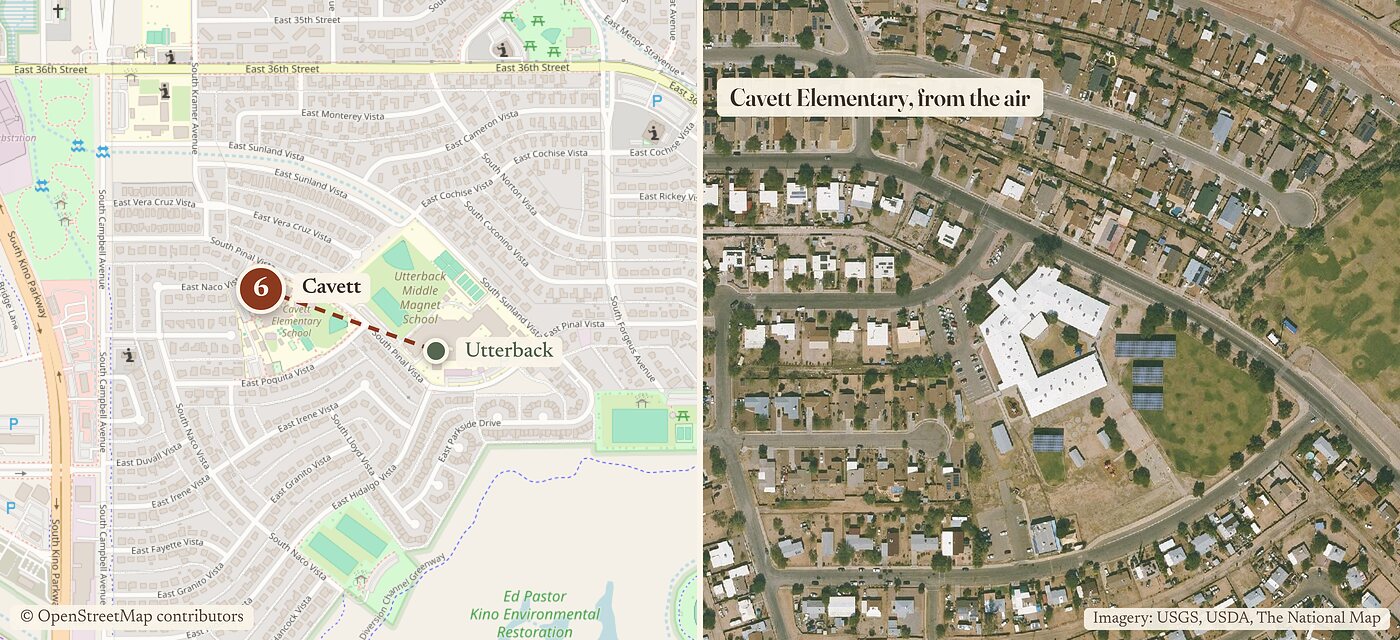
6. Cavett to Utterback (2028-29). The two campuses nearly touch, and Utterback would become a K-8, according to the Sentinel. Cavett has 203 students and Utterback 286. Unlike most of the list, Cavett isn't on the east side or in midtown. It has the second-largest savings estimate, $928,964. The plan would cut about six teaching positions, and two six-hour teacher assistants would go to kindergarten and third grade, which are each one student over the class-size limit. Cavett's principal would become an assistant principal, with their salary kept for 2028-29 only.
The Cavett building wouldn't be sold. On Nov. 10 the district said it would become an alternative education center, with one part serving students with autism who need a separate day setting and another serving elementary and middle school students with behavioral challenges, with the goal of returning them to their home schools. Staff said the center needs about 30 students to break even and that about 30 have been identified. Placements would be decided by each student's IEP team, which includes parents. Board member Val Romero pointed to two or three condemned portable classrooms outside Utterback and asked what it would cost to make the campus inviting. Trujillo promised a facilities cost breakdown.
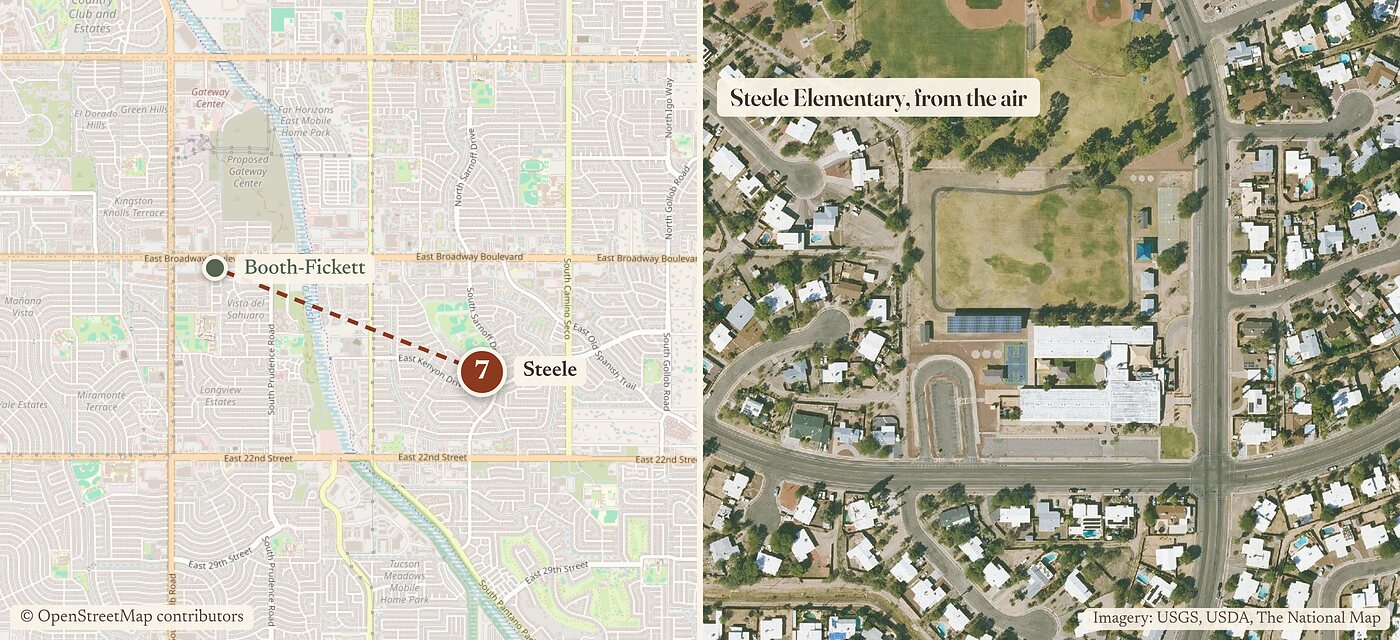
7. Steele to Booth-Fickett (2028-29). Harold Steele Elementary, a K-6 school at 700 S. Sarnoff Drive, would move into Booth-Fickett Math & Science K-8, at 50 S. Montego Drive. Both are on the east side, about 2 road miles apart and separated by the Pantano Wash, the Sentinel reported. Steele has 194 students and Booth-Fickett 282. By the state's count, Booth-Fickett has fallen from 1,184 students in 2010 to 244 last year, the steepest drop of any school on this list. It earned a C in the newest state grades, and Steele a D. Trujillo told the board Nov. 10 that the Steele proposal is "the least about budget." He said 43% of Steele's students are in exceptional education, and the move would place them among more general education peers with added support staff. The district projects the merged campus at 28% of capacity. The plan would cut about four teaching positions. The district's facilities evaluation lists a $5.2 million roof need at Booth-Fickett within five years, against $500,000 at Steele. Steele was the last school named, 34 days before the possible vote.
No longer proposed: Dunham to Marshall. Trujillo had proposed moving Dunham Elementary, with 124 students, into Marshall Elementary, 1.3 miles away. Dunham has the state's top grade, an A, and Marshall has a B, and board member Sadie Shaw asked on Oct. 27 why the move didn't go the other way. On Nov. 6, Trujillo wrote to Dunham families that its A rating marks three straight years of academic excellence. "For this reason, and after further consideration, our administration will no longer be recommending Dunham Elementary close and consolidate with Marshall Elementary," he wrote, KVOA reported. He said the district would work with the school's community on a plan to market and promote it.
Why is TUSD doing this?
Enrollment. "We have to solve declining enrollment. That's the number one issue facing this district," Trujillo told the board Oct. 27. By the state's count, TUSD had 53,307 students in October 2010 and 39,008 in October 2025, a drop of 26.8%. Its peak was 63,647 in 1973-74, the district says.
Competition. Of the 51,721 students living within TUSD's boundaries, 63.4% attend TUSD, 23.6% attend charter schools and 13% attend other districts, according to the same district presentation. Trujillo has said the east side is the focus because that's where TUSD risks losing families to the Tanque Verde and Catalina Foothills districts, the Sentinel reported.
Empty seats. TUSD says in the same presentation that its 88 schools are 58% full combined, with 28,180 empty seats. Each closing school here has shrunk faster than the district over 15 years:
| School | Role | Oct. 2010 | Oct. 2025 | Change | State grade, 2025-26 |
|---|---|---|---|---|---|
| Collier | closing | 300 | 111 | -63.0% | B |
| Magee | closing | 692 | 276 | -60.1% | C |
| Secrist | closing | 475 | 210 | -55.8% | C |
| Cragin | closing | 410 | 212 | -48.3% | B |
| Hudlow | closing | 281 | 162 | -42.3% | B |
| Cavett | closing | 300 | 205 | -31.7% | B |
| Steele | closing | 360 | 215 | -40.3% | D |
| Bloom | receiving | 345 | 330 | -4.3% | under review |
| Sabino | receiving | 1,240 | 788 | -36.5% | A |
| Blenman | receiving | 530 | 321 | -39.4% | B |
| Sewell | receiving | 323 | 169 | -47.7% | C |
| Utterback | receiving | 773 | 264 | -65.8% | C |
| Santa Rita | receiving | 1,098 | 368 | -66.5% | under review |
| Booth-Fickett | receiving | 1,184 | 244 | -79.4% | C |
| All of TUSD | 53,307 | 39,008 | -26.8% |
Source: Arizona Department of Education October 1 counts, including preschool; Arizona State Board of Education A-F grades. These are last year's counts, so they differ from TUSD's October 2026 figures above and shouldn't be compared directly.
Booth-Fickett, a math and science magnet school, served kindergarten through eighth grade in every one of those years. It had 1,184 students in October 2010 and 1,280 at its 2013 peak, and most of the drop came between 2015 and 2020.
Money. The district says closures are not mainly about the budget. "Is it a budget conversation? Sure. Partly," Trujillo said. But TUSD is on the state Auditor General's list of high-risk districts, and the deficit "stands at about $21M" before any closures, the district told us Nov. 6. Earlier district estimates ranged from about $6 million to about $27 million. If the closures happen, "in addition to other budget reductions we have not provided to the Board," the deficit "would essentially be cleared out by FY29," TUSD said. Chief Financial Officer Ricky Hernández said Oct. 6 that the closures alone won't fix it. "We know reconfiguration is not gonna get us to the finish line," he said.
Trujillo says the goal is better programs. "We simply cannot meet that need by spending millions of dollars in underutilized facilities," he said. Board member Jennifer Eckstrom said she had understood the process to be about the budget.
What would happen to my child?
The district has made several commitments. Some come with limits, and some details aren't settled.
Where students would go. They would be assigned to the receiving school in the table above, but "they can choose any school they prefer," TUSD told us Nov. 6. It isn't clear yet whether there's a deadline or whether those families would get priority.
Buses. "If a parent wants the bus, they're getting the bus," Trujillo told AZPM. TUSD told us the guarantee is permanent for students within the attendance boundary, "unless there are any revisions to the walk-zone policies in the future." It said costs will be calculated "once the routes are scheduled."
Free before- and after-school care. Trujillo said every elementary proposal includes it, which would leave out Magee and Secrist families. For the moves in 2028-29, the district's sheet for Cavett says the program would be free for that school year only. It would go to students from both the closing and the receiving school, including students from outside the district, TUSD told us. For the first round, it's free for one school year, 2027-28. "At least right now the commitment is to do that for a year," Hernández said. The district said "TUSD rebate funding" would pay for it, at about $150,000 for each new program. The cost of existing programs depends on how many new students join. Its written answer mentions after-school care, while Trujillo has described before- and after-school care. Some receiving schools use the city's KIDCO program, which a district staffer said doesn't offer before-school care, and which goes up 25% to $85 a month for city residents on July 1.
Special education. "ExEd programs travel together," Trujillo said. The district's scenario sheets leave open that some programs from Collier and Cragin could land at a school other than the receiving one.
Class sizes. The district projects averages around 18 to 21 students in the lower grades at merged elementaries, though classes vary by grade. Staff workrooms and counselors' offices at receiving schools would go back to being classrooms, Trujillo said.
School grades. The district's sheets list Cragin and Hudlow as D schools, but both earned a B in the State Board's newest grades, and Sewell, Hudlow's receiving school, slipped to a C. Bloom's is under review.
What would happen to teachers and staff?
AZPM reported that Trujillo said no employees would lose their jobs, at least through the end of the 2027-28 school year. TUSD told us Nov. 6 that it's "fully committed to achieving 100% retention for all continuing employees" at the closing schools.
That isn't a board action or a written policy yet. It's "currently an operational directive from Superintendent Trujillo," the district said, and TUSD hopes to formalize it through agreements with its labor partners. The plan is to move as many employees as possible to the receiving schools. If there's no match, HR would look for a spot in the employee's preferred area or elsewhere in the district, and would use temporary roles until permanent jobs open, through the end of 2027-28.
The five schools first proposed for 2027-28, Dunham included, have 120 school-based employees, TUSD said, plus about 50 exceptional education teachers and assistants who are expected to transfer to the receiving schools. Other staff who serve those schools would be reassigned by their departments.
Those five first proposals would have eliminated 39.8 full-time positions, including 15 teachers, according to the district's financial overview. Without Dunham, it's about 31.8, including 12 teachers, by the figures Hernández gave the board. The three newer proposals would eliminate about 19.6 more, including 12 teachers, for about 51 across all seven. Trujillo told the Star that staff would fill vacancies elsewhere, which means they may not stay with their school. Principals at the closing elementaries would become assistant principals at the receiving schools, with their pay held for a year.
How much would it save?
Less is settled here than the headline number suggests.
- About $2.2 million a year is the sum of the three scenarios for 2027-28, from the district's Oct. 27 financial overview. The four for 2028-29, Magee included, add about $2.4 million. Our math. The Oct. 27 overview's five first proposals, Dunham and Magee among them, came to $3.4 million, while the district's scenario sheets rounded them to $3.7 million. It isn't clear which is the net figure.
- About $4.6 million a year is the sum of all seven scenarios, from the Oct. 27 overview and the district's Nov. 10 overview. Our math.
- Up to $7 million a year is Trujillo's estimate for all the moves after 2028-29, not counting building sales, according to the Sentinel. We haven't found a published breakdown.
- Added costs: TUSD told us Nov. 6 that its estimates "do account for the additional childcare and transportation," and that aides are no longer going to Bloom. At the Oct. 27 meeting, Trujillo and Hernández said the free care wasn't in the savings figure, and the district also told us it hasn't calculated bus costs yet. The cost tables for the last three moves list neither care nor buses.
- What could change them: revenue lost if more families leave than expected. The projections assume 85% of a closing school's students go to the receiving school.
- Bonds. TUSD has spent more than $2.6 million from its 2023 bond at the first seven schools it named, Dunham included, the Star reported, and had planned more than $15 million. Unspent money would stay in the district's pool. "What the voters approved were not specific projects at specific schools," Hernández said. About $10 million in bond funds would be available from Hudlow, Cragin, Collier and Magee, and about $7.9 million from the last three.
- Buildings. The district's "very preliminary" values for Hudlow, Cragin, Collier and Magee total about $8 million, and its values for the last three total $5.9 million. Selling one requires voter approval, Trujillo said, and could take from three months to two years after that. Sale money can go only to capital costs, with a portion going toward reducing property taxes tied to bond debt, TUSD told us. It can't pay for operating costs such as salaries. Hernández said a measure on the 2028 presidential ballot might cost about half of the $850,000 the last mail-only election cost.
Some of the district's numbers conflict. The packet uses different enrollment counts in different documents, for example 132 or 172 at Hudlow. Its projected use of the merged schools also varies: 76% in one document and 96% in another at Sewell. For Collier, the widely repeated 38% is classroom use, while enrollment use is 28%. We've used the figures the district presented to the board and noted where they come from.
What happened the last time TUSD closed schools?
TUSD closed nine schools in 2010 and 11 in 2013, according to the district's own history.
Students. About 15% of students at those schools left TUSD afterward, compared with about 10% in a normal year. The district put the added loss at about 100 students in 2010 and 175 in 2013. That's where the 85% assumption comes from. The district's data also show that middle school students from the 2013 closures finished high school in TUSD at lower rates than their peers, a detail that matters for Magee and Secrist.
Receiving schools. In the state's counts, Secrist jumped from 365 to 631 students after the 2013 closures and now has 210. Blenman went from 421 to 495 and now has 321. Bloom is closer to where it was, going from 283 to 394 and now 330. All three are on this year's list, one as a closing school and two as receiving schools.
Savings. The 2013 closures were projected to save $4.5 million a year. "There's no evidence to really trace the specific" figure, Hernández told the board. The closures also didn't stop the enrollment decline. "It didn't reverse that enrollment decline," he said.
Who objects, and what are the alternatives?
Parents. Besides the Collier petition, Cragin parents had gathered more than 200 signatures by Oct. 30, KVOA reported. Several parents have told the board or reporters they would leave the district if their school closes. Others have asked why the smaller school is always the one to move, or asked the district to test its 85% assumption.
At the Nov. 10 meeting, public comment ran more than an hour. A Cragin parent group said its survey drew 40 responses representing 66 students, and 60% said they would leave TUSD if Cragin closed. The group asked the board to make Cragin a K-6 school and wait two to three years. Collier parents asked the board to consider a three-year pilot turning the school into an environmental learning program. One resident asked the district to roll back part of its voter-approved budget override if it closes schools, and Shaw asked staff to answer that question at a future meeting.
TUSD has also posted the written feedback from each school's meetings on its Reconfiguration page, as submitted. Much of the Magee-Sabino feedback is about putting 11-year-olds on a high school campus.
The board. Five members will decide. In August, the board voted 3-2 for the planning process, with Ravi Shah, Natalie Luna Rose and Val Romero in favor and Eckstrom and Shaw against. Those votes weren't on specific schools. "We are moving way too fast," Eckstrom said Oct. 27, repeating her request for a pause. Shaw said the rollout had been "less than perfect." Romero pointed to the risk of state intervention if the district stays on the Auditor General's list. Eckstrom said the district is "nowhere near that."
On Nov. 10, board members said they still lacked cost estimates for the facility work the moves would need. "I'm tired of waiting for information," one said. Shaw objected that Dunham was taken off the list without a board vote, and said closures won't fix the district's deficit.
The election. Eckstrom's and Romero's seats were on the Nov. 3 ballot. In Pima County's unofficial results as of Nov. 10, with every precinct reported, Eckstrom finished first with 74,026 votes and Pilar Acosta Ruiz took the second seat with 46,429, about 2,500 ahead of Romero. The county certifies the results Nov. 19. Board President Ravi Shah thanked Romero on Nov. 10 for his four years on the board. Winners take office in January, so the current board would take the Dec. 8 vote.
The process. A 31-member advisory committee ranked the options in closed meetings. TUSD told us it's an advisory group formed by the superintendent, not a board committee, so it isn't subject to the open meeting law. We asked for its records on Oct. 1. The district's records office told us Nov. 3 that it was forwarding our request to the right departments.
How can I weigh in?
| Date | What | Where |
|---|---|---|
| Tue., Nov. 17, 5:30 p.m. | Public hearing, the only item on the agenda | Sahuaro High School |
| Tue., Dec. 1 | Board meeting with a question-and-answer session on the plan | To be announced |
| Tue., Dec. 8 | Possible vote | Palo Verde High Magnet School |
- To speak: submit the board's request form by noon on the day of the meeting, or hand it to board staff at the meeting. The form and the latest details are on the Governing Board page.
- To write: email governingboard@tusd1.org by noon the day of the meeting. You can also call the board office at (520) 225-6070.
- Time limits: the Nov. 17 hearing follows the same rules as Oct. 27, TUSD told us, including three minutes for each speaker and the usual request form.
- Your legal right to notice: state law requires written notice, with the reasons, to the parents of all students in a district at least 10 days before a public meeting on closing a school. The board must then wait at least 10 days after that meeting to vote. TUSD told us the first notice went to all families by email on Oct. 30, and that the announcement is also on district and school websites and social media.
What's still unknown
- How the district will weigh the alternative proposals families have submitted, such as Collier's environmental pilot and Cragin's K-6 plan.
- The net savings for each proposal, and what the bus guarantee will cost.
- What it will cost to ready the receiving campuses. Trujillo promised the board a facilities breakdown Nov. 10.
- Who nominated the advisory committee's ward and supervisor-district members, and whether minutes or recordings exist.
How we reported this
We covered the board's Oct. 6, Oct. 20, Oct. 27 and Nov. 10 meetings, and quotes here without another source come from those meetings. We also read TUSD's Oct. 27 board packet and its Nov. 10 agenda documents, pulled 16 years of state enrollment counts and checked the current list on TUSD's own page on Nov. 11. Karla Escamilla, TUSD's communications director, answered our written questions Nov. 6. Where other outlets reported something first, we've linked them. Aerial images are from the U.S. government's National Map.
Have a question about the closures that we didn't answer? Email nicholas@tucsondailybrief.com.
Reported and written by Nicholas De Leon, with research and drafting assistance from Claude Opus 5.5; published at 9:33 AM MST on November 11, 2026. Read more about how this is made.
Comments
Join the conversation on Bluesky