One in Four Green Valley Homebuyers Lives Out of State. On Tucson's South Side, One in a Hundred.
Pima County's own sales records say more than a third of home sales involve an out-of-state address. Follow the new owners' mail instead, and the real share is under 8 percent, concentrated in a band of retirement and foothills ZIP codes where half the houses sell for cash. Tucson Daily Brief matched 19,794 single-family sales from January 2025 through August 2026 to the county's parcel file to find out who is buying, where, and how they pay.
What we found
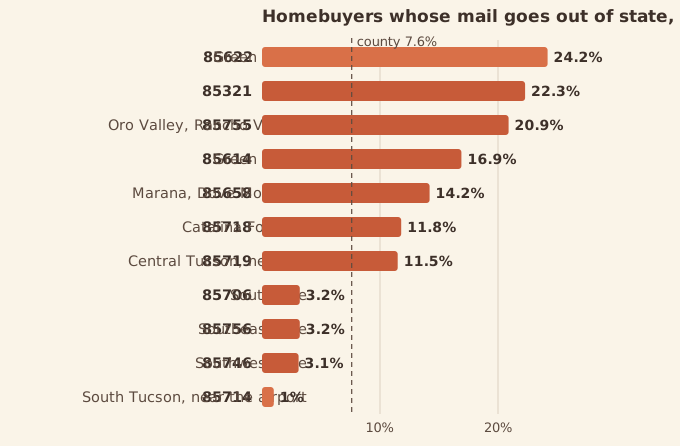
Across Pima County, 7.6 percent of the people who bought a single-family house in the last 20 months receive their property mail outside Arizona. Another 2 percent get it elsewhere in the state, mostly Phoenix, Tempe and Mesa. The rest, about nine in ten buyers, are local.
The countywide figure hides a gradient that runs from the retirement communities and foothills in the north and south to the working neighborhoods of the city:
| ZIP | Area | Sales | Out-of-state owners | Cash sales | Median price |
|---|---|---|---|---|---|
| 85622 | Green Valley | 215 | 24% | 54% | $415,000 |
| 85321 | Ajo | 113 | 22% | 47% | $147,000 |
| 85755 | Oro Valley, Rancho Vistoso | 806 | 21% | 43% | $558,000 |
| 85614 | Green Valley | 1,191 | 17% | 40% | $365,000 |
| 85658 | Marana, Dove Mountain | 854 | 14% | 31% | $585,000 |
| 85718 | Catalina Foothills | 570 | 12% | 35% | $912,500 |
| 85719 | Central Tucson, near the university | 443 | 12% | 33% | $395,000 |
| 85706 | South side | 436 | 3% | 8% | $285,000 |
| 85756 | Southeast side | 648 | 3% | 7% | $345,000 |
| 85746 | Southwest side | 445 | 3% | 11% | $308,000 |
| 85714 | South Tucson, near the airport | 104 | 1% | 14% | $247,500 |
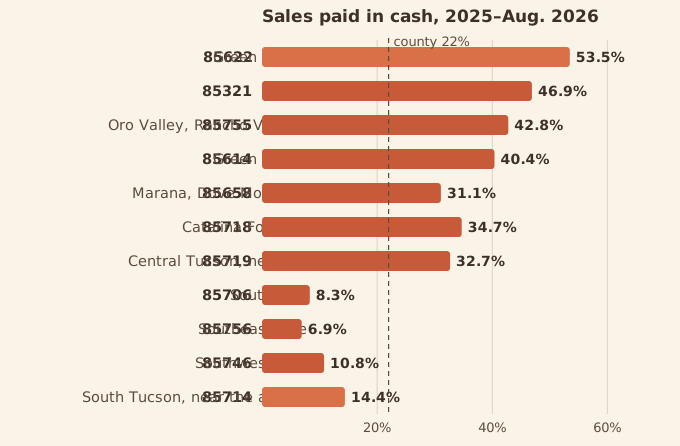
In Green Valley's 85622, one buyer in four lives out of state and more than half of sales close without a mortgage. In 85714, south of downtown, one buyer in a hundred lives out of state and one sale in seven is cash. The two ZIP codes are 25 miles apart.
Cash tracks the out-of-state share almost everywhere. Countywide, 22 percent of sales were cash. In the five ZIP codes with the most out-of-state owners, the cash share ranges from 31 to 54 percent; in the five with the fewest, from 7 to 15 percent. The exception is the neighborhoods around the University of Arizona, where a third of purchases are declared as rentals or second homes rather than primary residences, the highest share in the county outside Ajo.
Where the out-of-state buyers come from is not a surprise: California first, with 218 buyers, then Washington with 200, Colorado with 148, and Minnesota with 84. Wisconsin, Oregon, Utah and Texas follow.
Large investors are a smaller part of the picture than the national conversation suggests. Three entities bought 10 or more single-family houses in the period, 60 houses between them, out of nearly 20,000 sales. Under this site's rules for property data, owners are named only when they hold ten or more houses and a story requires it; this one does not.
How we got this data and how we analyzed it
Every sale in Pima County is reported to the County Assessor on an affidavit of property value, and the Assessor publishes the full file nightly. Tucson Daily Brief has archived that file since January 2023: 86,104 sales, each with the price, the type of financing, the buyer's declared intended use, and the Assessor's own validation code. Separately, the Assessor publishes a file of every parcel in the county, 448,360 of them, with the owner's mailing address. We take a snapshot of that file monthly.
This story joins the two. For each sale, we looked up the parcel's current owner and read the state from the mailing address. That is a proxy for where the buyer lives, and an imperfect one: a buyer who forwards mail to a Tucson property manager reads as local, and a snowbird who keeps a Minnesota address reads as out of state. We use it because it is the only residence signal in the public record, and because it is more specific than the Assessor's own flag. The Assessor marks a sale "buyer/seller has an out-of-state address" if either party does. That flag covers 36 percent of these sales. Measuring the buyer alone gives 7.6 percent, and 0.3 percent of owner addresses could not be read.
We counted only single-family houses in sales the Assessor validated as ordinary market transactions, priced $20,000 or more, excluding transfers between related parties, sales under duress and bundles of more than five parcels. That leaves 19,794 sales between January 2025 and August 2026, with a countywide median of $384,000. We did not use 2024 for the cash comparison because the Assessor's financing field was left blank on most 2024 records; 2025 and 2026 are complete.
ZIP codes are ours, not the Assessor's. The parcel file carries the owner's mailing ZIP, which for an out-of-state owner is the wrong one, so we assigned every parcel to a ZIP by its location, using the Census Bureau's ZIP Code Tabulation Areas. The table shows ZIP codes with at least 80 sales in the period; 35 qualify. No language model computed or wrote any figure here; the numbers come from database queries over the two files, and the What Sold page uses the same archive each week.
What it means
The county's headline number, that a third of sales touch an out-of-state party, is true and mostly reflects sellers leaving, not buyers arriving. The buyers arriving from out of state are real, and they are going to specific places: Green Valley, Oro Valley's newer subdivisions, Dove Mountain, the Catalina Foothills. Those are also the places where a house is most likely to be bought outright. On the south, southwest and southeast sides, nearly every buyer is local and nearly every purchase carries a mortgage.
That pattern matters for the fights already on local agendas. Oro Valley's council spent Wednesday night on where to steer annexation for retail revenue; its northern ZIP has one of the county's highest shares of out-of-state buyers. Marana's council is weighing growth against water; Dove Mountain's buyers pay cash at twice the county rate. The next edition of this analysis will look at whether those shares are rising, once the archive is long enough to say.
Corrections
If a figure looks wrong or a ZIP is mislabeled, write to nicholas@tucsondailybrief.com. Corrections are published on this page.
Reported and written by Nicholas De Leon, with research and drafting assistance from Claude Fable 5.1; published at 11:36 AM MST on September 17, 2026. Read more about how this is made.
Comments
Join the conversation on Bluesky